Tuesday, June 19, 2012

A Morning Walk


Today's post comes from Jen Ismirle, one of our summer interns. She writes about a lovely morning walk she recently had at Fenner and escaping the sounds of the city for just a few moments on our trails. 

After volunteering and now interning at Fenner for 6 months, I still had not walked around the trails beyond walking to the storage shed. So, a couple days ago, I decided it was definitely a must for me to explore all of the trails and see what I might find. If you haven’t already taken a look, here is a link to the trail map for Fenner: http://www.mynaturecenter.org/trailmap.

As I was told by naturalists at Fenner, the best time to see animals in the area is in the early morning or at dusk. I chose to go in the early morning to beat the heat, showing up not long after the trails open at 8am (and they are open every day!). I only saw two other people as I walked around the various trails, but I did see quite a few animals.

The first animal I encountered was by the bird feeders next to the Visitor Center – a turkey. Of course I saw many other various birds near the feeders, like chickadees. I also was surrounded by chipmunks at one point – 4 of them all around me, seemingly unbothered by my presence.


I had hoped to find some deer as I took some time to check out the observation blind, but what I found was a multitude of squirrels. The squirrels seemed very interested in me as a couple of them chewed on their food while staring at me at the same time as I walked by their trees. One even followed me, running to another branch to watch me as I meandered further.

Walking further along the trails left me feeling almost like I was in another world with the trees towering all around me. The sounds of the city were far away and it felt quite peaceful in the quiet, only interrupted by the rustling of small animals or the calls of birds. I especially loved stopping at the various ponds around Fenner to listen to the green frogs and the bullfrogs making sounds, which you can hear yourself here: http://youtu.be/2_X5Js_T-H4. I even found some turtles basking in the sun. 


So if you are looking for an escape from city life, even just for a moment, the trails of Fenner Nature Center will definitely provide this. Although I was accosted by a variety of insects at times (make sure to use bug spray before heading out on the trails!), I still thoroughly enjoyed my morning walk.

Wednesday, June 13, 2012

The Rewards of Monitoring


With the destruction and development of natural habitats and the introduction of non-native birds and outside cats, it has become much more difficult for wild birds to breed young that survive. Bluebirds are one species that has been drastically affected, but many are now working to help these beautiful birds. Providing nest boxes for birds in an area can help wild birds breed, but monitoring is also needed to make sure these boxes stay habitable and intact in order to protect the young birds inside.

The use of nest boxes has helped many species of birds increase from very low population numbers, along with the monitoring efforts of those such as our guest blogger today. Gene Wasserman is the Ingham, Clinton, and Eaton County Coordinator for the Michigan Bluebird Society. He monitors nest boxes extensively, and the following is an account of some things he observed this spring:

On one recent day of monitoring nest boxes at Harris Nature Center in Okemos and Fenner Nature Center in Lansing, I was lucky enough to observe the following:

I saw a Chickadee and its nest with
11 eggs (yes, 11!) and a new hatchling.
  • Wrens took over two old Bluebird nests.
  • Wrens had pecked Bluebird eggs in another nest.
  • I observed a Wren on another nest box that had seven eggs.
  • I saw a Bluebird nest with babies about 12 days old.                 
  • I saw a Tree Swallow nest with babies about three days old.
  • I saw a beautiful Chickadee nest with one egg, so far.
  • I saw a beautiful Bluebird at its nest box with two eggs so far.
  • Along the trail, I saw a female Cardinal on her nest with three eggs.
  • I removed a dead, adult Tree Swallow from a nest with three eggs and observed the Tree Swallows on the nest box.
  • I removed a nearby House Sparrow nest that had four eggs.
  • I saw a Tree Swallow nest with six eggs that was previously occupied by a House Sparrow that had a halo installed.

I observed four Bluebird babies
about nine days old
with a Tree Swallow on the nest box
even though the Bluebird was on her nest.
I removed an old Bluebird nest that fledged five
but was infested with blowfly.


This is why we need to monitor our nest boxes; so we can learn, enjoy, and be responsible stewards for our environment.  If I had not, I would have missed a very rewarding day.

Monday, June 11, 2012

A Moment Alone

 Today's guest post comes from Brendan, who works with the Greater Lansing Convention and Visitors Bureau, and his original post can be found on The Buzz Blog. Brendan writes about "a cool moment" he had at Fenner when he thought he was alone.

As an official photographer during the 18th Annual Be A Tourist In Your Own Town event held last Saturday June 2nd here in Greater Lansing, I obviously saw a bunch of cool things. The most memorable though was not when I was downtown Lansing, surrounded by thousands of local “tourists” and not even as I waited in an ever-growing line of Spartan fans to tour some awesome campus history at Beaumont Tower. Nope. The most memorable moment I had was when I pulled into Fenner Nature Center. I didn’t see a lot of cars, but I wasn’t too surprised. With over 60 attractions now participating in Be A tourist, it’s not un-common to go to one spot and they are experiencing a temporary lull in the action as people hit other attractions all over town, wait for busses, grab lunch, etc.

So as I walked into the nature center I thought that I was going to have some relaxing time alone in this awesome, scenic natural area. Sounded pretty nice. I could not have been more wrong. It was certainly nice but it turns out I was WAY off about being alone.

Animals at Fenner, like this muskrat, keep you company
while you enjoy some time alone.
As I crossed the parking lot I saw about 4 or 5 different birds flying from tree to tree. I get a little closer to the nature center building and a 3-foot snake made his way across my path, sending me nearly running up a tree nearby, as I’m not a huge fan of serpents. I know, it’s not justified, they just have always creeped me out. Running out of the direction of the snake sent me around the corner of the building structure, back to the huge pond behind. Even though I’m not a fan of snakes it was cool to get my heart rate going a bit with the scare, you know? So as I began to chill out from that I thought the pond looked good, so I head over that way and I see a turtle about the size of a small pizza climb out from under a bush and plop into the pond! Right as I’m thinking, “Good grief, how much wildlife can you pack into a 4 minute span?” I step onto this little dock area and look down over the edge and see this cute little guy, pictured here on the left, swimming right toward me! I didn’t even know what it was at first. He looked like a super mouse of some kind, taking a dip in the hot afternoon sun. After he swam away I was thinking about how cute he was, and what he might be doing in the water and I saw all at once a bunch of little fish, frogs and tadpoles swimming around. I think he was doing his version of grocery shopping. The water, and the entire nature center was teaming with life, and here I was, thinking I was alone. The place was packed. It’s just I was the only one wearing pants and speaking English.

Do you want a cool moment like this? Where you don’t have to say a word and you can simply look around and see creatures of the earth enjoying their habitat? No cell phones, no interruptions, no tweets (except real ones from the birds). Consider this your invitation to check out Fenner Nature Center near the intersection of Mt. Hope and Aurelius road in Lansing.

Come get some of the busiest, most crowded peace and solitude you’ll ever find.

Wednesday, May 23, 2012

When I Was a Kid

Today's post is written by our Executive Director, Jason Meyer. He writes from a parent's perspective about the importance of children developing a sense of wonder by spending time in nature.

When I was a kid, I rode the bus to school. I didn’t walk five miles uphill both ways in three feet of snow…bare foot. And no matter what my Dad told me, I don’t really believe he did either. He usually told me this as he was pointing out some lesson I had just learned about how hard life was.  And last night, as I was helping one of my own children learn about life, I actually caught myself saying, “When I was a kid, I walked to school….”

And in saying that, I learned another valuable lesson from Dad. No matter how much I try not to, I find myself becoming more and more like him on a daily basis. I haven’t gone as far as chaining the trailer to the gas meter so nobody would steal it and then driving off, but I’ve come to realize that somehow someway I will wreak havoc of that magnitude unintentionally, too. In spending about half of my life with the man, I learned that saying “I’ll never be like that,” only makes it more likely to happen.

While I cruise through life (just waiting for the day that the gas meter drags along behind me), I can’t help but think about what my kids are learning from me. My wife and I have made some pretty deliberate decisions to “bring them up right” – like choosing to live out in the country where the type of education that our children receive will include things like where the wood for our stove that heats the house comes from or why the tadpoles they put in the wading pool with all of that mud didn’t survive the winter. 

For an outdoorsman, though, I find myself overly worried about the kids when they are outside. “Don’t climb that high.” “That’s enough of that playing by the stinging nettle patch.” “Stop throwing dirt into the air.” Sheesh. I must be the most fun dad in the world, huh?

Against my better wishes, they continue to practice civil disobedience of my laws out of earshot. In many ways they are growing up wild and free, no matter how much I inadvertently try to squelch that by “providing guidance.” They know where the blackberry patches are.  Two of the three have poison ivy right now. They all have bumps and scratches from falling out of trees and they’ve had leeches from the creek in some pretty interesting places. They climb up and down the rock pile in their bare feet. They carry dirt from the garden around under their fingernails. They have even figured out that sunscreen makes pretty good hair gel. 
 
When I really think about it, though, I don’t want them to be like me – always worrying about what COULD happen. I love that they have little fear about the adventure that awaits behind the potting shed. The unfortunate thing about all of this is that in today’s world, children who have these types of experiences are abnormal. Ok, the KIDS aren’t abnormal, but their experiences are. 

I want to see a world where children are encouraged to play, to explore, to develop their own philosophies about the world before society tells them what’s “appropriate” and what’s not. I love to see children running, digging, looking under rocks and logs, and smelling the flowers. Unfortunately for them, these explorations are stifled because they MIGHT get hurt, or worse yet….DIRTY. 

Here’s the thing – we all have a lot to learn from our kids. And you don’t need to live out in the country to learn these lessons. You can do it right here in the heart of Lansing at Fenner Nature Center. Whether you are exploring the park with just your family or they are enrolled in one of our nature day camps or the Fenner Field School, these lessons are underfoot. And if you listen closely enough to what your kids are saying while they are here, you’ll remember what it was like to WONDER about things – I mean really really wonder. And wondering is a lesson we could all stand to re-learn.

Tuesday, May 8, 2012

No, we won't tell you where... Fenner's secret stash of morels

Before I even start, I have to tell you all that we don’t allow collecting of anything—berries, nuts, woodchucks, whatever—at Fenner. As much fun as it can be to go stomping out into the woods with a bucket or a grocery sack and come home with edible foraged goodies, Fenner is an oasis of nature in an urban area and we want to make sure that everybody in Lansing has a chance to see the species that call it home. This means that you cannot take those species home for your personal enjoyment…no matter how delightful they may be. If we catch you, you will get in trouble. 
 
With this disclaimer out of the way, we have morel mushrooms. These wrinkly, gray-to-brown delicacies are growing on our property. Found in hardwood forests all over the United States, morels grow in mid-spring and their season is upon us! In Michigan, morels can often be found poking up through the leaf litter on forest floors among trilliums and jack-in-the-pulpits. The mushrooms grow in clusters or “messes,” so where one morel is spotted there are most likely others nearby. If you see a morel, look for bulges in the leaf litter. These often conceal the other members of its mess. 

Morels are easily distinguishable by their pitted, wrinkly caps. These caps are connected to the stem, which is hollow. There is only one major poisonous look-alike: the false morel. False morels have caps that are brain or saddle-shaped. Their caps, unlike true morel caps, hang around the stem instead of being connected. Once you know this difference, it’s pretty hard to confuse the two.

Morels are delicious, but you have to prepare them correctly or you can get some unpleasant results. First, it’s best to soak them overnight in salt water to kill any insects that might be lingering in their hollows. Next, you need to cook them before eating them. While raw morels won’t kill you, they can make you sick. I recommend sautéing them in butter with some garlic, as this generally enhances the taste of almost all wild-foraged foods. From there, they are delicious in pasta dishes, on pizza, on Philly cheesesteak sandwiches, or anywhere else that you would normally put mushrooms.

In today’s ultra-cautionary world, mushroom foraging is put in the same category of daring as bungee jumping and tiger-wrestling.  As far as morels are concerned, however, safety is only a matter of being properly informed. Now that you are, feel free to go out looking for them! Just remember to make sure you follow these identification and preparation instructions closely. That, and make sure that the morels you pick are not at Fenner. Not that you know where ours are anyway…  

Tuesday, April 24, 2012

A parent's point of view: Learning about maple syrup with a Fenner homeschool program

Today's guest post comes from a community member and parent who attended one of our homeschool programs last month. Melissa writes the blog Cookies, Crayons, Classes & Chaos, and she was generous enough to write a post describing what she learned when her homeschool group attended a maple syrup tour at Fenner! We can't fit her entire post here, but be sure to visit the link at the bottom to see her entire post. She gives some great information about how maple syrup is made, as well as lovely photographs of the animals they encountered on their trip to Fenner.
Well, that was an interesting homeschool tour today!! Usually when our family has gone to the Maple Syrup festivals in the spring we want to cuddle up next to the warm fires where the syrup is boiling. Not so much today. Today, the campfire evoked thoughts of hot dogs, s'mores, and swimming holes, and we could use the smoke to keep the mosquitoes away instead of warming ourselves. Hard to believe it was almost 80 degrees!  I suppose this unseasonable warm weather is going to make Maple Syrup expensive since it cut the sap collecting season short.


Tree Anatomy

Lynette first taught everyone about tree anatomy using a nifty felt tree with felt "flappy" layers that peeled back to reveal each layer.

Learning about tree anatomy from Lynette using the felt tree

We learned about the trees layers starting from the outside: Bark, cambium, xylem, phloem, heartwood.

The tree rings are formed from the cambium when the xylem dies each year.

Learn more about how tree rings are formed at Real Trees 4 Kids.


Diagram from Tree Boss

"While the center of the trunk is usually "just wood" (Heartwood), the inner bark consists of living tissue. These layers are known as the Phloem and the Cambium, with the cambium being the growth layer....

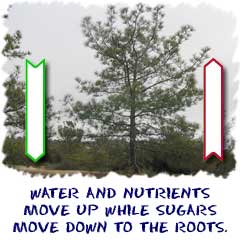
"The xylem transports water and nutrients up the tree, and phloem transports products of photosynthesis back down." -- Tree Boss


How Sap Flows

We learned that the sap would freeze during the winter and make the tree "explode".  So the tree sends all its sap to the roots during the winter.

When the weather warms up during the day the sap rises and then goes back down to the roots when the temperatures go below freezing at night.

Sap, the tree's nutrients, move up and down the tree in a loop during this cycle of warm and cold periods. 


Biology 4 Kids


To read the rest of this wonderful post, click here.

Thursday, April 5, 2012

Have fun and make a difference at Earth Day Extravaganza: Sunday, April 22nd


Every day we hear about environmental destruction in our world, and it may leave you thinking there is nothing you can do to make much of a difference. You CAN make a difference! On April 22nd, people around the world will stand up for the protection of our earth and participate in local events that celebrate our home planet. Together, we will call attention to environmental issues around the world and celebrate the nature we have all around us!

An exciting Earth Day Extravaganza will be held here at Fenner Nature Center, presented in partnership with the MSU Fisheries and Wildlife Club and the help of many other local organizations like The Nature Conservancy. This day of nature career exploration and stewardship features a variety of informative activities such as bird identification hikes, interactive presentations about native Michigan animals, wildflower identification hikes, and the opportunity to form a team and join our garlic mustard pull challenge! We are also kicking off our Butterfly Garden Restoration with the help of the Capital Area Master Gardeners.

As you enjoy all the activities of the day, don’t miss one of our most exciting events: Picnic for the Planet! With your help, the Nature Conservancy hopes to break the Guinness World Record for the most people picnicking in a 24-hour period around the world! Come enjoy the activities inside the visitor center and on the trails, and remember to bring a sack lunch so you can join The Nature Conservancy and make history!

Here is a schedule for the activities of Earth Day Extravaganza:
      Mist Netting: 7:00 am – 9:00
      Guided Bird Walk: 8:00 am – 9:00 am; 10:30 am – 11:30 am
      Wildflower Identification Hike: 9:30 am – 10:30 am; 1:30 pm – 2:30 pm
      Small Mammal Trapping: 9:30 am – 10:30 am
      Garlic Mustard Pull Challenge: 9:00 am – 3:00 pm
      Native Animal Presentation: 11:45 am – 12:45 pm
      Tree Identification Hike: 10:30 am – 11:30 am
      Pond Dipping: 11:00 am – 3: 00 am
      Herpetological Surveys: 12:30 pm – 2:30 pm
      Picnic for the Planet: 11:00am, 12:00pm, 1:00pm
      Bluebird nest checks: TBD
      Michigan Wildlife presentations: 10:00 am – 3:00 pm

Whether you intend to get your hands a little dirty and join us to help rid the park of invasive plants, create new habitat for butterflies and other integral pollinators, or simply come out to learn about nature and spend time outdoors with family and friends, we are certain that it will be an unforgettable day.

PNC Bank will also be on-site with their Mobile LearningAdventure! Be sure to stop by, check it out, and get your little ones involved in their interactive exhibits.

We hope to see you at Fenner Nature Center on April 22 for Earth Day Extravaganza!

For more information and updates, “like” our facebook page