Tuesday, April 24, 2012

A parent's point of view: Learning about maple syrup with a Fenner homeschool program

Today's guest post comes from a community member and parent who attended one of our homeschool programs last month. Melissa writes the blog Cookies, Crayons, Classes & Chaos, and she was generous enough to write a post describing what she learned when her homeschool group attended a maple syrup tour at Fenner! We can't fit her entire post here, but be sure to visit the link at the bottom to see her entire post. She gives some great information about how maple syrup is made, as well as lovely photographs of the animals they encountered on their trip to Fenner.
Well, that was an interesting homeschool tour today!! Usually when our family has gone to the Maple Syrup festivals in the spring we want to cuddle up next to the warm fires where the syrup is boiling. Not so much today. Today, the campfire evoked thoughts of hot dogs, s'mores, and swimming holes, and we could use the smoke to keep the mosquitoes away instead of warming ourselves. Hard to believe it was almost 80 degrees!  I suppose this unseasonable warm weather is going to make Maple Syrup expensive since it cut the sap collecting season short.


Tree Anatomy

Lynette first taught everyone about tree anatomy using a nifty felt tree with felt "flappy" layers that peeled back to reveal each layer.

Learning about tree anatomy from Lynette using the felt tree

We learned about the trees layers starting from the outside: Bark, cambium, xylem, phloem, heartwood.

The tree rings are formed from the cambium when the xylem dies each year.

Learn more about how tree rings are formed at Real Trees 4 Kids.


Diagram from Tree Boss

"While the center of the trunk is usually "just wood" (Heartwood), the inner bark consists of living tissue. These layers are known as the Phloem and the Cambium, with the cambium being the growth layer....

"The xylem transports water and nutrients up the tree, and phloem transports products of photosynthesis back down." -- Tree Boss


How Sap Flows

We learned that the sap would freeze during the winter and make the tree "explode".  So the tree sends all its sap to the roots during the winter.

When the weather warms up during the day the sap rises and then goes back down to the roots when the temperatures go below freezing at night.

Sap, the tree's nutrients, move up and down the tree in a loop during this cycle of warm and cold periods. 
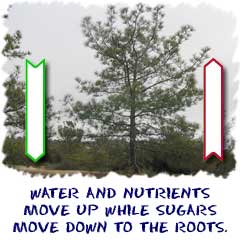


Biology 4 Kids


To read the rest of this wonderful post, click here.

Thursday, April 5, 2012

Have fun and make a difference at Earth Day Extravaganza: Sunday, April 22nd


Every day we hear about environmental destruction in our world, and it may leave you thinking there is nothing you can do to make much of a difference. You CAN make a difference! On April 22nd, people around the world will stand up for the protection of our earth and participate in local events that celebrate our home planet. Together, we will call attention to environmental issues around the world and celebrate the nature we have all around us!

An exciting Earth Day Extravaganza will be held here at Fenner Nature Center, presented in partnership with the MSU Fisheries and Wildlife Club and the help of many other local organizations like The Nature Conservancy. This day of nature career exploration and stewardship features a variety of informative activities such as bird identification hikes, interactive presentations about native Michigan animals, wildflower identification hikes, and the opportunity to form a team and join our garlic mustard pull challenge! We are also kicking off our Butterfly Garden Restoration with the help of the Capital Area Master Gardeners.

As you enjoy all the activities of the day, don’t miss one of our most exciting events: Picnic for the Planet! With your help, the Nature Conservancy hopes to break the Guinness World Record for the most people picnicking in a 24-hour period around the world! Come enjoy the activities inside the visitor center and on the trails, and remember to bring a sack lunch so you can join The Nature Conservancy and make history!

Here is a schedule for the activities of Earth Day Extravaganza:
      Mist Netting: 7:00 am – 9:00
      Guided Bird Walk: 8:00 am – 9:00 am; 10:30 am – 11:30 am
      Wildflower Identification Hike: 9:30 am – 10:30 am; 1:30 pm – 2:30 pm
      Small Mammal Trapping: 9:30 am – 10:30 am
      Garlic Mustard Pull Challenge: 9:00 am – 3:00 pm
      Native Animal Presentation: 11:45 am – 12:45 pm
      Tree Identification Hike: 10:30 am – 11:30 am
      Pond Dipping: 11:00 am – 3: 00 am
      Herpetological Surveys: 12:30 pm – 2:30 pm
      Picnic for the Planet: 11:00am, 12:00pm, 1:00pm
      Bluebird nest checks: TBD
      Michigan Wildlife presentations: 10:00 am – 3:00 pm

Whether you intend to get your hands a little dirty and join us to help rid the park of invasive plants, create new habitat for butterflies and other integral pollinators, or simply come out to learn about nature and spend time outdoors with family and friends, we are certain that it will be an unforgettable day.

PNC Bank will also be on-site with their Mobile LearningAdventure! Be sure to stop by, check it out, and get your little ones involved in their interactive exhibits.

We hope to see you at Fenner Nature Center on April 22 for Earth Day Extravaganza!

For more information and updates, “like” our facebook page

Tuesday, March 27, 2012

Skunk Cabbage: the lovable oddball of Fenner’s swamps and marshes


Today's post is written by Lynette Score, one of our passionate naturalists here at the nature center. She writes about skunk cabbage, a telltale sign of spring in the marsh.

Check out our new woodchip trail- the one that branches off to the left soon after passing the vermicompost bins on the east side of the building. If you keep your eyes open as you enter the swamp, you might notice a purple plant with green spots growing in the marshy soil. No, you are not seeing things- this is skunk cabbage! 

skunk cabbage at Fenner Nature Center
Skunk cabbage is among the first plants to appear above ground after the winter (not that we really had a winter this year, but if we did…). While all the other plants are still dormant as seeds or bulbs or rhizomes in the frozen ground, skunk cabbage is already out and about. The first part of the plant to emerge, which is what you will see if you head out there now, is called the spathe. This is the purple, green-spotted thing I told you about. Skunk cabbage spathes emerge as early as February. If there had been any snow in the swamp this winter, you would have seen a snow-free circle around each spathe. This is because skunk cabbage spathes emit heat. No joke!

As the skunk cabbage matures further, a clump of small yellow flowers called the spadix forms inside the spathe. When the actual leaves unfurl in late spring, they are huge- up to a couple of feet long! If you crush a piece of a skunk cabbage leaf in your hand and smell it, you’ll understand how the plant gets its name. It definitely smells like a skunk. When the plant is fully mature, it forms an underground fruit that looks like a brain! This fruit has been rumored to have many medicinal uses including the treatment of convulsions, cough, and skin ailments. The Iroquois used the seeds from the fruit in fertility rituals. Talk about a cure-all!

Some people might try to tell you that skunk cabbage leaves are edible. Don’t believe them. Raw skunk cabbage leaves are toxic to mammals, which we are. Skunk cabbage leaves also contain calcium oxalate crystals, which cause a painful burning sensation in your mouth if you eat them. The theory behind eating skunk cabbage, as with a lot of “edible” plants, is that if you boil it enough it will become more palatable and safe to eat. This is also probably true of your belt, but that doesn’t mean that you should eat it. Furthermore, it is very difficult to remove all the calcium oxalate crystals, even with boiling. Getting to eat something that tastes not-painful at best isn’t worth the risk of getting sick or hurting your mouth.

Skunk cabbage is, however, an important resource for many species. Many small invertebrates eat the leaves, and the size of the leaves also makes them a great shelter source for small animals of all sorts. Since they aren’t affected by the calcium oxalate crystals and don’t seem to mind the smell, we’ll let them enjoy skunk cabbage as food and shelter. As for us, I would say there’s enough fun to be had by simply wondering at this oddball of a plant. 

Sources
www.fcps.edu/islandcreekes/ecology/skunk_cabbage.htm
www.wildmanstevebrill.com

Thursday, March 15, 2012

Volunteering at Fenner

Our guest post today is written by Cait Quinn, one of our enthusiastic volunteers. She writes about what it's like to volunteer at Fenner!

Hello!

My name is Cait and I’m going to be guest blogging for you all today! I’m a volunteer at Fenner and, like all of you wonderful supporters of the nature center, have fallen in love with the place! Everyday I come in, I never quite know what to expect. One day I could be emptying sap from maple trees, and the next I could be feeding all of our little creatures inside. There is always something new to help out with, and that sparked my interest to stay involved. I leave here always having something to talk about with my friends. For instance, did you know that Fenner used to have a prairie dog facility? After going through some files on my first day, I came across some old letters written by past Fenner employees requesting that the town of Lubbock, Texas catch and ship about a dozen prairie dogs to be a new exhibit for the nature center. What a cool thing to come across!

And in the Texan correspondent’s letter back to Fenner, the writer mentioned that they have been catching prairie dogs for many different cities around the US and even the world. Their most recent endeavor (as of March 1960) was sending prairie dogs to the King of Morocco. So our Fenner prairie dogs could have been from royal descent!

There is so much history here at Fenner and in our Lansing community that I encourage all of you to take advantage of. Fenner is so community oriented, and that definitely influenced my decision to continue volunteering here. Within the first hour I arrived I knew everyone’s name, they knew mine, and we could all joke around like we had known each other a lot longer. I think that’s the key to having such a successful nature center, because in the end, these 134 acres are for us all, not just those who hike the trails or study the outdoors. It’s for every resident to take advantage of! Come see our friendly turkeys outside the visitor center, hike the trails, learn about our maple syrup trees, sign up for a program and maybe even spot a deer or two while you’re here! And of course, come get to know the wonderful people who work for Fenner. We are glad to have you.

P.S. Join us for a pancake dinner on Saturday, March 17th at 4:00pm to celebrate and enjoy all the maple syrup we have made this year! I was just outside today emptying all the sap, and boy do we have a ton. So come enjoy our delicious syrup with some equally excellent pancakes.

Monday, March 12, 2012

Whitetail deer at Fenner Nature Center

Today's post is written by Lynette Score, one of our passionate naturalists here at the nature center. She writes about whitetail deer and how to find them at Fenner.

If you walk our trails, especially at dawn or dusk, you are likely to come across this graceful mammal. Found in every county in Michigan, the Whitetail Deer is a common but nonetheless breathtaking sight. Named for its fluffy white tail which it uses as a “danger flag” to signal its fellow deer, the whitetail plays an important but delicately balanced role in Michigan ecosystems.

As large predator populations that feed on the whitetail (primarily wolves and cougars) have been driven away and/or endangered by humans, the species’ Michigan population has skyrocketed out of control. Deer graze the forest bare in the winter, often starving to death and making it difficult for other species to find food. For this reason, many environmental experts now recommend deer hunting as a population management technique. While deer hunting is not permitted at Fenner, you should definitely try wild-caught venison the next chance you get. It will help regulate deer overpopulation and delight your taste buds at the same time!

Some fun facts about whitetail deer:
  • They can run 35 miles per hour, jump over obstacles 8 feet high, and cover 30 feet in a single bound (Peterson Field Guide). 
  • They have hollow hairs which provide insulation and help them float when they swim (Michigan DNR).
  • They live in family groups of up to 25 individuals. Each group is usually led by a female deer, or a doe (DNR).
  • Some female deer have antlers (DNR).
Find them at Fenner!

some recently sighted deer tracks
  • You can easily spot Whitetail Deer along our trails near dawn or dusk. The deer also visit our birdfeeders from time to time and steal the cracked corn!
  • At this time of year, the mud and snow on the ground make it easy to spot Whitetail Deer tracks.
  • In the autumn, male deer rub their antlers on trees to mark their territory. When you see trees with the bark scraped off, this is often the cause.


Tuesday, March 6, 2012

Connecting children with nature

When I see birches bend left to right…
I like to think some boy’s been swinging them.
- Robert Frost
Robert Frost’s sentimental hope for seeing children swinging on tree branches is a hope that many of us here at Fenner Nature Center share. As a naturalist and program educator, nothing makes me happier than seeing children delight in being outdoors. Many of our visitors come from urban areas where green spaces are hard to find. Unlike many people from an older generation, they aren’t growing up exploring the woods behind their house or rescuing baby birds from their backyard. Instead, they are attending schools that have been forced to cut recess time, and living in neighborhoods where outdoor play is too hard to access.

While this saddens many nature-lovers, it could in fact be a bigger problem than we thought. “Nature deficit disorder,” a term coined by author and nature advocate Richard Louv, is a trend across the country. In his ground-breaking book Last Child in the Woods: Saving Our Children from Nature-Deficit Disorder, Louv outlines a number of studies linking reduced time in nature to all sorts of issues: obesity, attention disorders, depression. Louv’s book describes these studies in detail, and is well worth the read. But the long and short of it is this: being in nature encourages people to be active, which helps fight obesity. Being in nature helps children process information and become curious about the world around them, which combats attention disorders. And exposure to nature helps children resist negative stresses and depression. Plus, free play and exploration is a vital part of healthy child development.

While many societal factors have caused nature deficit disorder to be an all too common problem among children, there are some easy solutions we can implement. Communities need nature centers, parks, and green spaces. Schools need time and funding for field trips to these places. Teachers need training on how to use nature as a teaching tool. And, above all, families need the ability and desire to spend time in nature with their children.

Fenner Nature Center offers many free and low-cost ways for your family to get outside. Our free hiking trails are open every day, dawn to dusk. Elementary-age children can sign up for our spring break and summer camps, where they will spend their days exploring outdoors and learning about nature. Teachers can bring their classes for educational tours. Preschoolers and toddlers can participate in our Knee High Naturalist programs on Wednesdays and Thursdays. In March we are also offering a winter night hike, a worm composting class, a nature story hour, and a maple syrup festival. For more information on these programs and many more, visit our website or call us at 517-483-4224.

Thursday, March 1, 2012

Welcome to our blog!

We are excited to announce the publication of Fenner Nature Center's new blog. As part of our mission to connect people to nature in the heart of Lansing, we'll be posting articles on everything nature related. Topics will include information on plants and animals here at the nature center, resources for connecting your family with nature, and announcements about exciting events at Fenner.

Subscribe by email by entering your address in the box on the right. Our blog is also accessible via our website, mynaturecenter.org.

Thanks, and have a wonderful day in nature!